
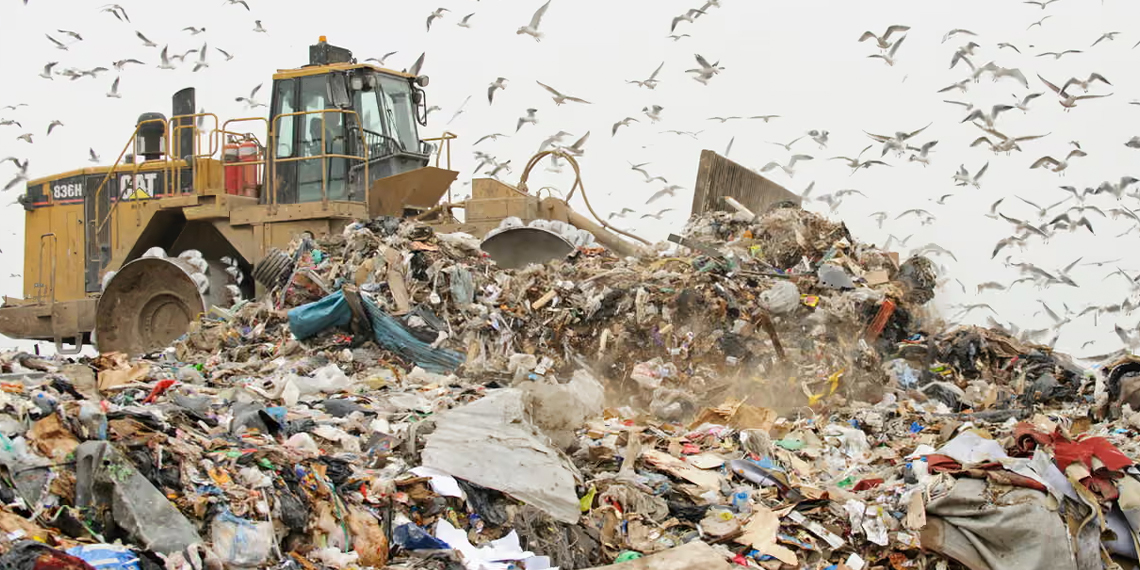
Thousands of landfills across the UK and Europe are located in floodplains and could leak toxic waste into rivers, soils and drinking water sources as climate change increases flooding and erosion, a major investigation has revealed.
The analysis — the first continent-wide mapping of landfill sites, carried out by the Guardian, Watershed Investigations and Investigate Europe — highlights the growing environmental threat posed by old waste dumps, many of which predate modern pollution regulations.
Patrick Byrne of Liverpool John Moores University warned: “With increasing frequency and magnitudes of floods and erosion from climate change, there’s a greater risk of these wastes washing into our environment. This includes physical waste like plastics and building materials, but also toxic metals and chemicals such as Pfas [‘forever chemicals’] and PCBs.”
Across the EU, there are estimated to be up to 500,000 landfill sites, around 90% of which were created before modern pollution controls such as liners and leachate management systems. The UK alone has around 22,000 historic sites.
New mapping identified more than 61,000 landfill sites across Europe, with 28% located in areas vulnerable to flooding. Modelling suggests the true number of flood-risk sites could be as high as 140,000. The investigation also exposed widespread data gaps, with EU institutions lacking centralised landfill databases and member state records often incomplete or inaccessible.
Kate Spencer, professor of environmental geochemistry at Queen Mary University of London, said: “It’s the worst possible scenario. Most landfills will be fine, but you only need a small number of sites which contain very toxic chemicals to be a problem. We just don’t know which ones.”
She added that coastal landfills are especially exposed, noting that researchers found “hospital blood bags” and other hazardous materials eroding out of an old site in Tilbury.
More than half of the mapped landfills sit in areas where groundwater fails to meet chemical quality standards, raising concerns that some sites may already be polluting surrounding environments.
Byrne’s research at the Newgate nature reserve in Wilmslow, Cheshire, found PFAS “forever chemicals” leaking from a historic landfill at 20 times the acceptable level for drinking water.
In Greece, tests at the former Maratholaka landfill showed PFAS contamination many times above safe limits, along with mercury and cadmium entering the Nedontas river.
Local authorities insisted that the landfill no longer operates, saying there is currently “no evidence or data to substantiate any environmental impact”.
Almost 10,000 landfill sites identified in the investigation are located within drinking water zones across France, the UK, Spain, Germany, the Netherlands and Italy. More than 4,000 of these sites are in England and Wales.
Byrne cautioned: “We don’t and won’t know how much risk to human health and our drinking water there is until you can identify where all the landfills are, what is in them, whether they’re leaching and if treatment processes are filtering them out.”
The investigation found 335 landfills in coastal erosion zones in England, Wales and France, and a total of 258 sites across Europe within 200 metres of the shoreline. These sites are at risk from erosion, storm surges and rising sea levels.
Spencer is working with Defra to rank the 1,200 highest-risk landfills in England and Wales. She warned that two tested coastal sites had already released dangerous pollutants: Lynemouth in the north-east showed elevated arsenic levels, while Lyme Regis in the south-west was leaking lead.
She said: “We now need to understand the potential risks of climate change and associated pollution release at all our historic landfill sites, not just the coastal ones,” adding that significant investment would be required to address the problem.
“Essentially we are all living on a garbage dump,” Spencer added, noting that around 80% of the UK population lives within 2km of a landfill, disproportionately in more deprived areas.
Illegal dumping is also worsening the situation. Europol has identified illicit waste disposal as one of Europe’s fastest-growing organised crime activities. In February, 13 suspects were arrested in Croatia for dumping at least 35,000 tonnes of waste from Italy, Slovenia and Germany — generating €4m in profits.
In England, the Environment Agency is investigating 137 illegal dump sites involving more than 1 million cubic metres of waste. In Italy’s Campania region, mafia-linked toxic dumping has been blamed for increased disease rates.
The UK’s Health Security Agency has said that living near a well-managed active or closed landfill does not pose a significant risk, though it acknowledged major data gaps for historic sites.
An Environment Agency spokesperson said: “Our job is to protect people and the environment, and we are working closely with the landfill industry, water companies and across government to better understand the impacts from Pfas chemicals in landfills.”
A Defra spokesperson added: “We are committed to reducing the amount of waste being sent to landfill … safeguarding the value of our resources and preventing the nation’s waste going to landfill.”