
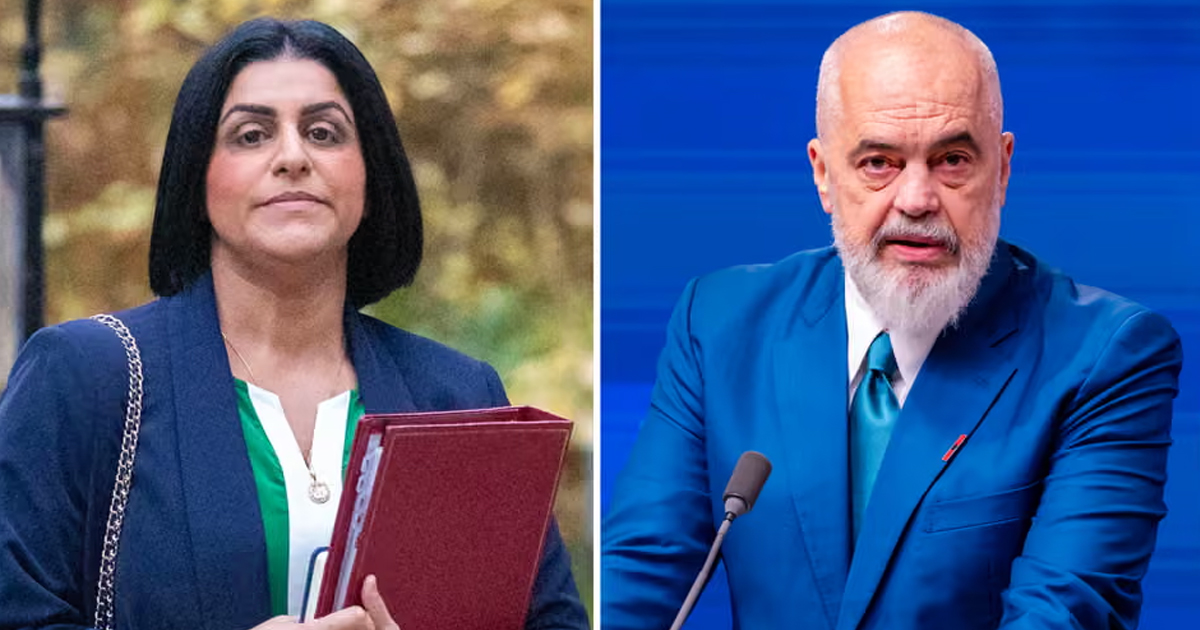
Albania’s prime minister, Edi Rama, has sharply criticised UK Home Secretary Shabana Mahmood, accusing her of “ethnic stereotyping” and “indecent demagoguery” after she singled out Albanian families refusing to return home as part of a new asylum policy. Mahmood’s officials had identified around 700 Albanian families for removal from the UK, prompting an angry response from Tirana and growing unease within the Labour Party.
In a post on X, Rama questioned how a Labour politician could “so poorly echo the rhetoric of the populist far-right,” particularly at a time when London and Tirana have been cooperating closely on migration and border security. He accused the UK government of repeatedly scapegoating Albanians despite their positive economic contributions.
“Albanians are net contributors to the British economy, and the number receiving UK benefits is very low relative to other communities. To single them out again and again is not policy – it is a troubling and indecent exercise in demagoguery,” he said.
Rama argued that the UK should be deepening security cooperation with Albania rather than “exposing citizens of an allied nation to increased risks,” warning that such rhetoric fuels extremist narratives. He insisted that UK policy “should never be driven by ethnic stereotyping.”
Labour MPs unhappy as Mahmood pushes ahead with forced returns
Mahmood is facing criticism from more than two dozen Labour MPs over planned measures that would see families forcibly removed if they decline voluntary return payments. The home secretary insisted the UK must remove families whose asylum claims have been rejected, saying Albania is a safe country and a signatory to the European Convention on Human Rights.
“Today, we are not removing family groups, even when we know their home country is perfectly safe,” she said. “There are around 700 Albanian families living in taxpayer-funded accommodation after failed asylum claims. We will now begin the removal of families.” She added that voluntary return would be preferred, but enforced removal would be used when necessary.
Tensions quietly rising between UK and Albania
An Albanian government source said relations with the UK were becoming strained, despite previously successful joint efforts to reduce irregular migration. The UK and Albania have cooperated closely since 2022, when Albanian nationals represented a significant share of small-boat arrivals. Since then, arrivals have reportedly dropped by more than 90%, and Albanian asylum claims remain low.
UK border officers deployed across the western Balkans
Rama’s intervention has caused discomfort in Whitehall, where officials view the western Balkans as a key migration transit route. UK border security officers were sent to Albania, Serbia, Montenegro, Kosovo, North Macedonia and Bosnia and Herzegovina over the summer to strengthen intelligence networks and disrupt smuggling gangs. Senior officials fear that political tension could undermine these efforts.
Analysts warn UK rhetoric is again targeting Albanians
Andi Hoxhaj, an associate fellow at the Royal United Services Institute (RUSI), said the government appeared to be reviving a narrative that previously angered Albania.
“We saw the same issue under the previous Conservative administration,” he said. “This rhetoric seems tied to the government’s push to reinterpret ECHR provisions on family rights – using Albanians as the example, just as Reform UK and the Conservatives have done.”
He added that naming Albania directly aligns with the messaging promoted by Nigel Farage, who has repeatedly singled out Albanians in his speeches.
Historical tension over UK home secretaries
This is not the first clash between Rama and a UK home secretary. In November 2022, he accused Suella Braverman of “fuelling xenophobia” after she claimed some Albanians were abusing modern slavery laws to seek asylum in Britain. Mahmood’s office has not yet commented on the latest dispute.
