France has stepped back from its demand that the UK pay into EU funds upfront, clearing the path for long-awaited Brexit reset negotiations aimed at cutting the cost of food imports.
The move delivers a timely boost to No 10 ahead of the Budget, as EU ambassadors finally gave approval for formal trade talks.
For months, progress appeared at risk of collapse after France insisted that Britain start contributing immediately to EU budgets in exchange for reduced barriers to the single market. However, a coalition led by Germany, the Netherlands, Ireland, Belgium and Luxembourg warned that pushing too hard could jeopardise the entire reset before discussions even began.
The breakthrough ends days of deadlock and underscores how complicated the Brexit reset remains, with EU nations divided on how much – and how soon – the UK should pay.
Earlier this week, The i Paper revealed that the UK was prepared to walk away from an agreement granting access to the EU’s defence fund due to pressure to pay up to €6.5bn (£5.7bn).
A No 10 spokesperson stressed on Thursday that Britain would only contribute to EU schemes if there were clear advantages. “Nothing has been agreed yet … we’ve always said that if a proportionate contribution to a specific EU system would result in tangible benefits to the UK, then that is the sensible, fair and pragmatic decision we will take.”
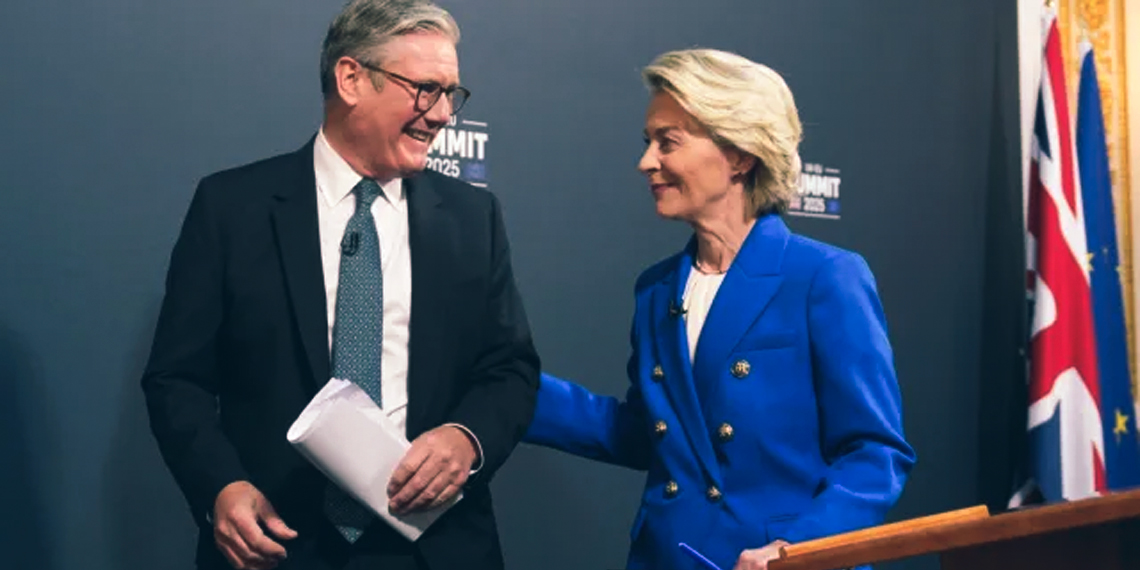
Keir Starmer and EU Commission President Ursula von der Leyen agreed in May to open a new chapter of cooperation. Cabinet Office minister Nick Thomas-Symonds, who is overseeing the Brexit reset, said at the time that he was “confident” a deal on food could be secured.
A senior Whitehall source told The i Paper that securing smoother food trade would be one of the “biggest wins” of the reset, boosting the economy while giving businesses and consumers much-needed certainty.
An EU official confirmed that ambassadors had finally “agreed on a compromise proposal that effectively takes as its basis the agreement from last May”. That London summit agreement included no explicit requirement for cohesion payments, easing tensions over funding.
The new mandate authorises the European Commission to begin negotiations on a sanitary and phytosanitary (SPS) deal. This agreement would align UK rules with EU food and animal-health standards, drastically reducing checks on goods crossing the Channel and helping ease long-running frictions over trade between Great Britain and Northern Ireland.
Ambassadors also approved talks on linking the EU and UK emissions trading systems (ETS), a step crucial for British exporters hoping to avoid the EU’s incoming carbon border levy, which comes into force on 1 January. Officials warned, however, that full integration will take years.
In addition, EU member states agreed to speed up preparations for a new electricity trading agreement. Following strong lobbying from Germany, the Netherlands and Belgium, the Commission has been asked to draft a mandate by the end of December. Restoring efficient cross-Channel power trading is seen as key to reducing energy prices and supporting investment in North Sea renewables.
Despite progress, disputes over UK financial contributions remain unresolved. While the UK has shown a willingness to pay for programmes that provide clear national benefits – such as Horizon Europe – ministers reject any open-ended commitment to EU budgets.
Starmer’s government has already pushed back against the EU’s initial request for up to €6.5bn to join the SAFE defence programme, insisting it must offer “value for money”. Diplomats said the Commission updated ambassadors on defence negotiations but did not seek permission to begin formal talks.
Political urgency is growing in London. Starmer wants the SPS agreement in place by 2027, arguing the benefits must be felt before the next general election. Yet experts warn the target is “sporty”, with complex regulatory alignment required and several EU states concerned the UK is underestimating the challenge.
EU ministers are expected to formally endorse the SPS and ETS mandates at the General Affairs Council on Monday, allowing negotiations to start next week. Following a call with Starmer, von der Leyen confirmed both sides aim for “mutually beneficial outcomes” – especially on SPS and SAFE.
The renewed momentum was welcomed by Naomi Smith, chief executive of Best for Britain. “These talks are vital to cutting costs at the checkout and reducing energy bills for both Brits and people in the EU,” she said. “Recognising the tangible benefits of closer EU-UK alignment, both sides must now act swiftly to make it a reality.”
However, a new House of Lords report, Unfinished Business: resetting the UK-EU relationship, warns the reset will require far more detailed agreements than currently proposed. It also cautions that SPS and ETS alignment will require ongoing updates to match evolving EU rules, urging ministers to clarify what they consider a “fair” UK contribution before moving into the next phase of negotiations.