
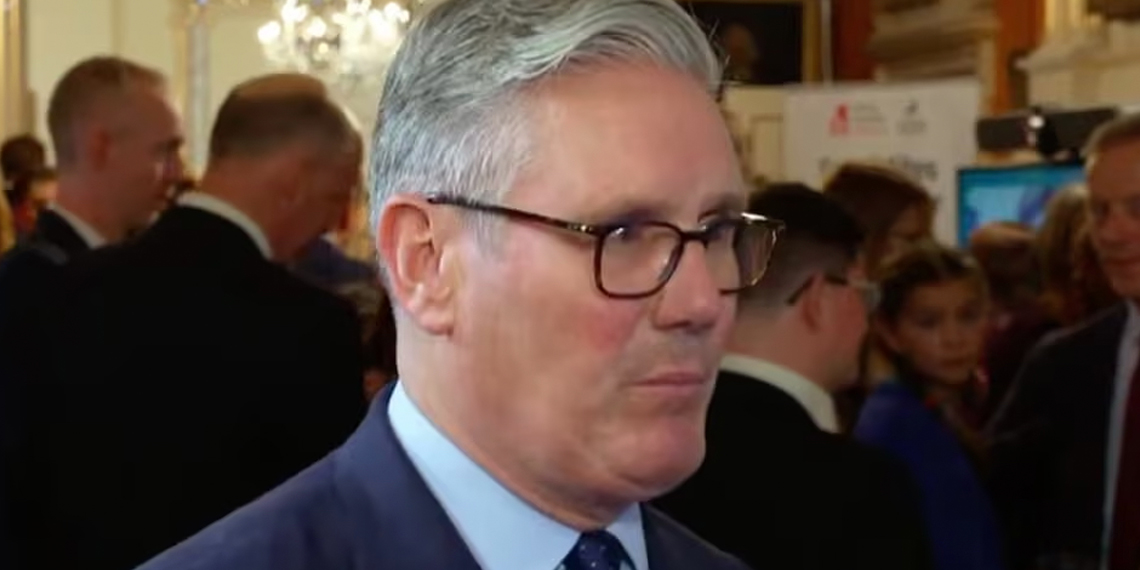
In a televised interview with GP and TV personality Amir Khan on the Lorraine show, Keir Starmer, Prime Minister of the United Kingdom, issued a stark warning that “divisive hard-right politics” is again tearing the country apart. He accused the party Reform UK — led by Nigel Farage — of overseeing a resurgence of racist and divisive rhetoric that he believed had been dealt with decades ago.
Starmer said: “Some of the rhetoric we’re hearing — racist rhetoric, divisive rhetoric — that frankly I thought we had dealt with decades ago is returning to politics and it makes people feel very scared.”
He drew a contrast between his party’s vision of “patriotic national renewal” and what he described as the “toxic division of Reform and others on the right of politics.”
Racism and political fault-lines
Starmer highlighted that the choice facing voters is between a Britain defined by inclusivity, compassion and shared national identity — and one dominated by fear, division and exclusion. He said: “We have to stand up to that racism, that division, and we have to proudly say that to be British is to have concern for others, is to be reasonable, is to be tolerant and compassionate, and we’re proud of that.”
He referenced recent remarks by Wes Streeting, the Health Secretary, who warned that an “ugly” racism reminiscent of the 1970s and 1980s had become worryingly commonplace, particularly directed at NHS staff.
Political analysts point to the changing landscape in Britain: the hard-right is gaining ground, and mainstream parties are grappling with how to respond. A recent commentary argued that the UK “resists radical ideologies” no longer, even as the rise of Reform UK signals that the far-right is making new inroads.
Child poverty and the two-child benefit cap
Alongside his remarks on social cohesion, Starmer issued his strongest signal yet that the controversial two-child benefit cap will be lifted in the budget later this month.
Under the current system, families are barred from claiming certain benefits for any children born after the first two.
Pressed on the question of scrapping the cap, Starmer said: “I can tell you in no uncertain terms I am determined to drive child poverty down.” He added that he wouldn’t be making such a pledge if he wasn’t clear that “we will be taking a number of measures in order to do so.”
Chancellor Rachel Reeves echoed the message on BBC Radio 5 Live: “In the end, a child should not be penalised because their parents don’t have very much money.”
Research by the Child Poverty Action Group (CPAG) suggests that lifting the cap could immediately lift some 400,000 children out of poverty and reduce deeper deprivation for hundreds of thousands more.
Ministers are reportedly preparing to lift the cap entirely, with estimated costs of about £3.5 billion by 2029-30.
Political stakes and wider context
Starmer has repeatedly stressed that the battle lines run between inclusive patriotism and populist nationalism. In his speech at the Labour Party Conference in September, he framed the contest as “a fight for the soul of our country”.
The rise of Reform UK, and its increasingly bold anti-immigration and populist messaging, has rattled the broader UK political landscape. For example, the party has called for mass deportations and questioned whether Muslim citizens respect “British values”.
At the same time, the welfare reform emphasised by lifting the two-child cap signals a shift in the Labour government’s policy from austerity-style measures toward tackling childhood deprivation more proactively. This dual-track approach — combining social justice with a rejection of hard-right populism — is at the heart of Starmer’s current political messaging.
What this means for Britain
If carried out, scrapping the two-child benefit cap would mark a major policy reversal for the Labour government, which initially chose to keep the cap in place after entering office, citing fiscal constraints.
Such a move could provide a lifeline to large families in low-income households, but will also increase pressure on public finances amid economic headwinds. The government will need to balance the cost of lifting the cap with its other commitments in public services and infrastructure.
On the social cohesion front, by publicly confronting the resurgence of divisive politics and racism, Starmer aims to redefine what it means to be British: not a matter of ethnicity or origin, but shared values of tolerance, compassion and community. Whether this message resonates with voters facing economic uncertainty remains to be seen.
Key takeaways:
•The Prime Minister warns that decades-old racist and divisive political rhetoric is returning — with the far-right playing a central role in this resurgence.
•Labour signals a major shift in welfare policy: the two-child benefit cap is expected to be lifted, part of a broader drive to reduce child poverty.
•The political battle is cast as one between inclusive national renewal and populist division; the next budget will serve as a key marker of how deeply the government is willing to reverse past policies.
