
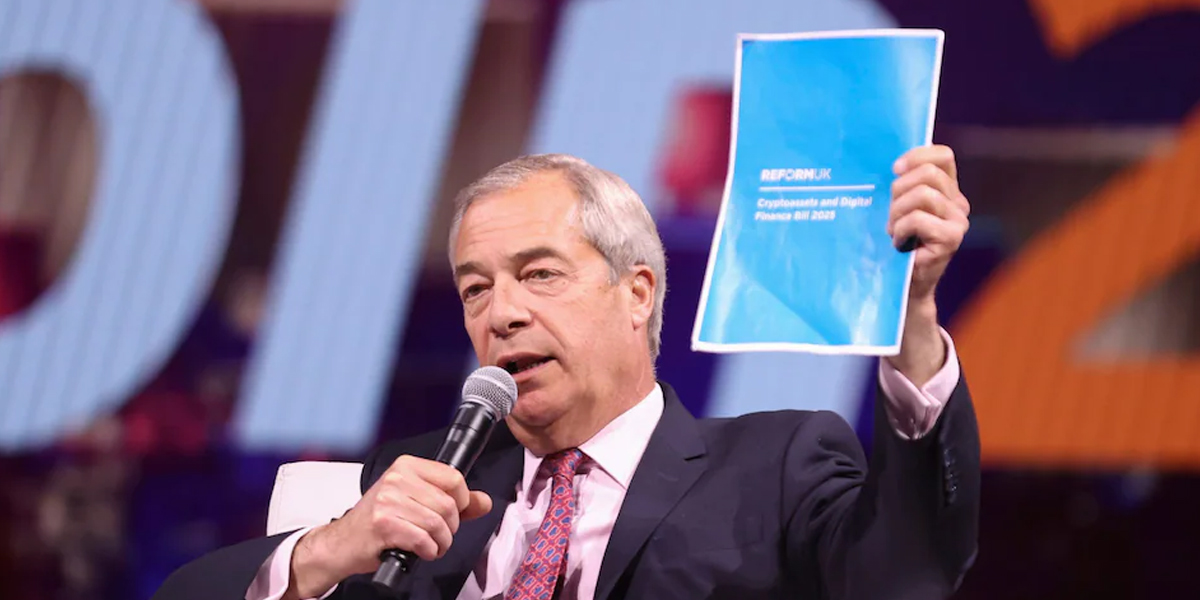
Nigel Farage has sharply criticised the Bank of England for what he described as “dinosaur bureaucrats” holding back Britain’s progress in cryptocurrency adoption.
The Reform UK leader claimed the central bank is stifling innovation and costing the country a chance to become a global leader in digital assets.
The criticism follows the Bank’s announcement that it plans to cap ownership of stablecoins at £20,000 for individuals and £10m for businesses. Stablecoins differ from traditional cryptocurrencies like Bitcoin, as they are pegged to established currencies such as the pound or dollar, and are designed to be less volatile.
Supporters argue stablecoins could transform payments by offering a fast, cheap and private way to transfer money internationally. However, the Bank of England has expressed concern that large-scale adoption could weaken the financial system by diverting cash away from traditional banks.
Writing in The Telegraph, Mr Farage and Zia Yusuf, former Reform UK chairman, said the restrictions risk damaging the economy and even denting demand for UK government bonds. They wrote: “Make no mistake: what the Bank announced is not some minor technical tweak. It is another example of unelected bureaucrats doing the most foolish thing possible and choking off British innovation and competitiveness.”
They warned the move would “reduce relative demand for UK gilts and push the City of London further behind its global rivals”.
The pair also criticised the lack of parliamentary oversight, stating: “For too long, our country has allowed unelected, dinosaur bureaucrats to make the rules that govern the future of our financial system. Parliament and thus the elected representatives of the British people has abdicated responsibility for setting direction. The consequence is obvious: Britain is losing ground.”
The global stablecoin market is estimated at nearly $300bn (£222bn), and industry figures say the UK risks falling behind countries with more flexible frameworks. Chancellor Rachel Reeves is expected to push forward with plans to support cryptocurrency innovation, potentially putting her at odds with Bank of England Governor Andrew Bailey, who previously told MPs he would need “a lot of convincing that the use case was made”.
Mr Farage and Mr Yusuf said that if elected, they would enable widespread use of cryptocurrencies. They wrote: “We have a choice. We can let the Bank of England cap innovation, stifle entrepreneurs and push capital offshore – or we can seize the opportunity, set the rules in Parliament and lead the world.”
The Bank of England is also exploring a central bank digital currency, sometimes referred to as a “digital pound”. This has triggered concerns over privacy and state control. Mr Farage and Mr Yusuf insisted they would “never” support the move, warning: “A ‘digital pound’ run directly by the state would hand unprecedented control over our money to the Bank of England and create the very opposite of the open, competitive financial system we need.”
Instead, they argued: “The future must be built on innovation from the ground up, with private sector stablecoins properly regulated, not imposed from the top down by a government-mandated currency.”