
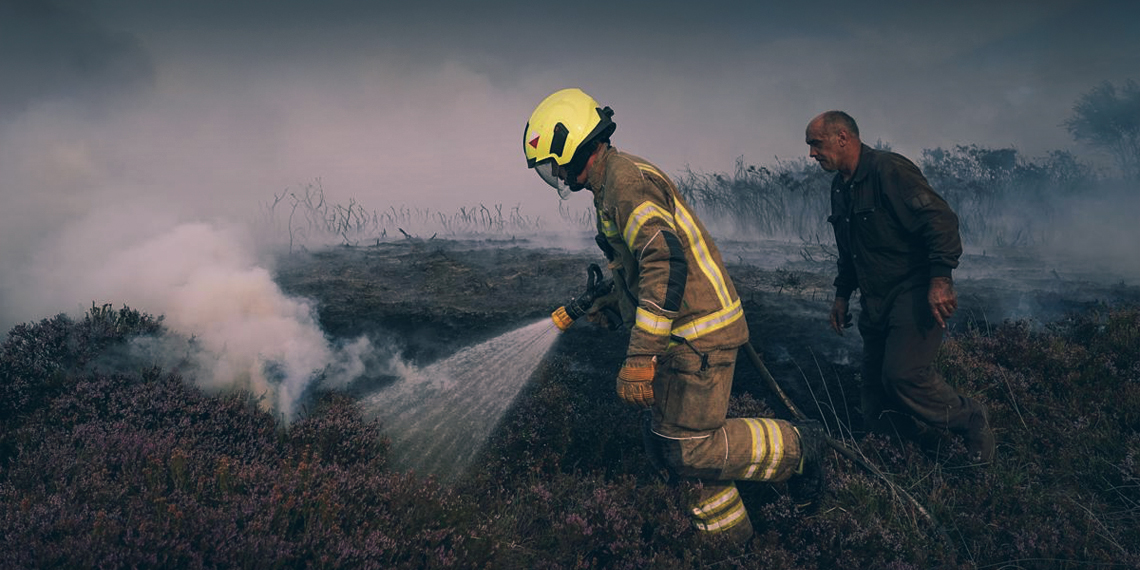
Live-fire military exercises have triggered hundreds of wildfires across the British countryside since 2023, with unexploded shells and ordnance often making it too dangerous for firefighters to bring the blazes under control.
Fire crews tackling a major moorland blaze in North Yorkshire earlier this month were hampered by bombs and tank shells left over from Second World War training on the moors.
According to figures obtained by the BBC, of the 439 wildfires recorded on Ministry of Defence (MoD) land between January 2023 and last month, 385 were caused directly by modern-day military manoeuvres.
The MoD said it has a robust wildfire policy that monitors risks and limits the use of live ammunition when necessary. However, local residents near affected sites have argued that more must be done, with some calling for live-fire training to be banned during the driest months.
Wildfires can begin for many reasons, including discarded cigarettes, campfires, barbecues and deliberate arson, but dry weather and dense vegetation often intensify their spread. Yet data obtained under the Freedom of Information Act shows that military exercises remain the leading cause on MoD land, with 1,178 wildfires linked to training sites since 2020.
In the first six months of this year alone, 101 out of 134 wildfires on MoD land were sparked by training activities. Over 80 of these occurred within designated Range Danger Areas, also known as impact zones, where fire services are usually barred from entry due to the risk of explosions. These fires are typically left to burn out within firebreaks, producing large amounts of smoke that can disrupt travel and pose health risks to nearby communities.
Residents in Wiltshire and North Yorkshire have voiced their concerns. Neil Lockhart, from Great Cheverell near Salisbury Plain, said the smoke was a serious issue: “If you suffer like I do with asthma, and it’s the height of the summer and you’ve got to keep all your windows closed, then it’s an issue.”
Arable farmer Tim Daw, whose land overlooks Salisbury Plain, said he had witnessed several large fires this year and described the scorched land as resembling a “burnt savannah”, although he praised the MoD for keeping locals informed about risks.
The problem is worsened by unexploded ordnance left behind from historic military training. In August, a wildfire on Langdale Moor in the North York Moors National Park set off explosions from Second World War-era shells. Landowner George Winn-Darley said the blaze produced “an enormous cloud of pollution” and argued that the fire could have been extinguished far sooner if old munitions had been cleared.
“It seems ridiculous that here we are, 80 years after the end of the Second World War, and we’re still dealing with this legacy,” he told the BBC.
The MoD confirmed that while the Langdale fire did not start on its land, its bomb disposal team had been called in several times by police to deal with discovered ordnance, which was later declared inert.
The department said it continually monitors wildfire risks across its training estate and restricts the use of explosives during periods of high danger. Measures such as firebreaks and managed grazing are used to limit combustible vegetation.
Earlier this month, the MoD also launched its “Respect the Range” campaign to raise public awareness of dangers on military training land, including live firing, unexploded shells and wildfires.
A spokeswoman for the National Fire Chiefs Council said it works closely with the MoD to manage risks: “We always encourage military colleagues to account for the conditions and the potential for wildfire when considering when to carry out their training.”
