
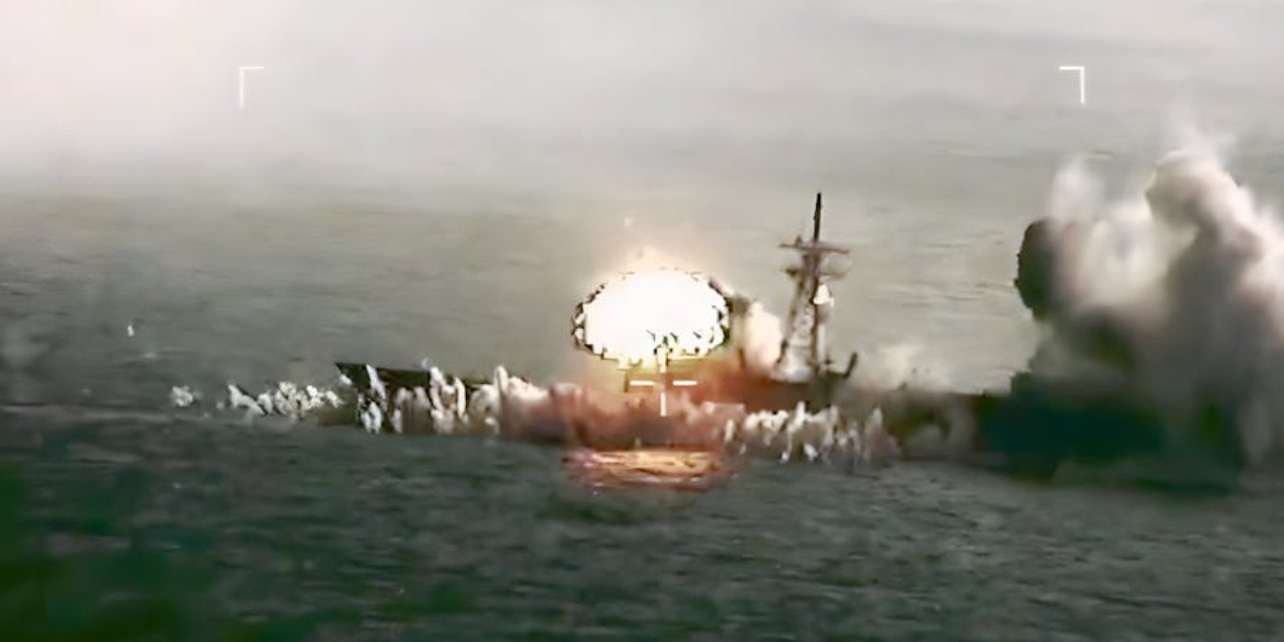
The Ministry of Defence (MoD) has revealed plans for Atlantic Thunder 26, a large-scale US–UK live-fire exercise set to take place in May 2026 at the QinetiQ Hebrides Range in northwest Scotland.
The drill will culminate in a dramatic sinking exercise (SINKEX), in which British and American naval and air forces will strike and destroy a target ship.
A SINKEX involves the use of real munitions against a decommissioned vessel to test advanced weapons systems, tactics, and interoperability under realistic combat conditions. According to the MoD, Atlantic Thunder 26 is a joint operation “designed to validate SUW kill chains, build resilient kill webs and deliver strategic messaging through kinetic demonstration” in Scottish waters.
Once the target ship is sunk, the wreck will settle at depths of around 6,000 feet. Uncrewed underwater vehicles (UUVs) will then be deployed to conduct battle damage assessment and seabed surveys, offering both a technological trial and a demonstration of allied cooperation in maritime warfare.
The upcoming drill follows Atlantic Thunder 22, carried out in 2022, when the Royal Navy and US Navy coordinated to sink the decommissioned USS Boone off the Hebrides.
That exercise saw HMS Diamond, USS Arleigh Burke, RAF Typhoon jets, and US Navy P-8 Poseidon aircraft execute a combined strike with multiple weapons. It was described as the most complex multinational SINKEX ever staged in UK waters, underlining the firepower and operational integration of British and American forces.
The MoD has issued a Request for Information (RFI) to invite industry partners to contribute to Atlantic Thunder 26. The Royal Navy’s Develop Directorate is seeking proposals by 12 September 2025, with a review board scheduled later that month. Selected companies will then join the planning cycle for the operational experimentation phase.
The ministry emphasises that this will not be a showcase event, but a developmental exercise aimed at addressing critical capability gaps. The RFI notes, “Whilst AT26 presents opportunities to showcase technology, and for Industry contributions to be highlighted during the exercise to an appropriate audience, it must be understood that this is a development exercise. The focus will be on accelerating capability delivery by addressing the capability blockers listed.”
Particular attention will be placed on uncrewed underwater vehicles, capable of scanning and analysing battle damage at extreme depths. Areas of interest include:
• High-resolution scanning at up to 6,000 feet
• AI-driven autonomous mission systems
• Long-endurance, low-signature platforms
• Innovative launch and recovery methods
• Advanced communications in bandwidth-limited environments
• Solutions for cross-domain integration of systems
The ministry requires all proposed systems to be fully operational and integrated into the exercise’s command-and-control structure from the outset.
The MoD outlines seven core outcomes for Atlantic Thunder 26, including advancing its understanding of emerging technologies, aligning requirements with industry standards, and shaping future procurement strategies. The RFI further highlights goals to “accelerate national and bilateral Maritime Uncrewed Systems development programmes… drive interoperability and interchangeability in MUS… and promote the operational exploitation of MUS capabilities to fulfil the maritime capability gaps.”
By combining live-fire strikes with advanced underwater technology trials, Atlantic Thunder 26 is expected to demonstrate the future of maritime warfare and allied integration in UK waters.
