
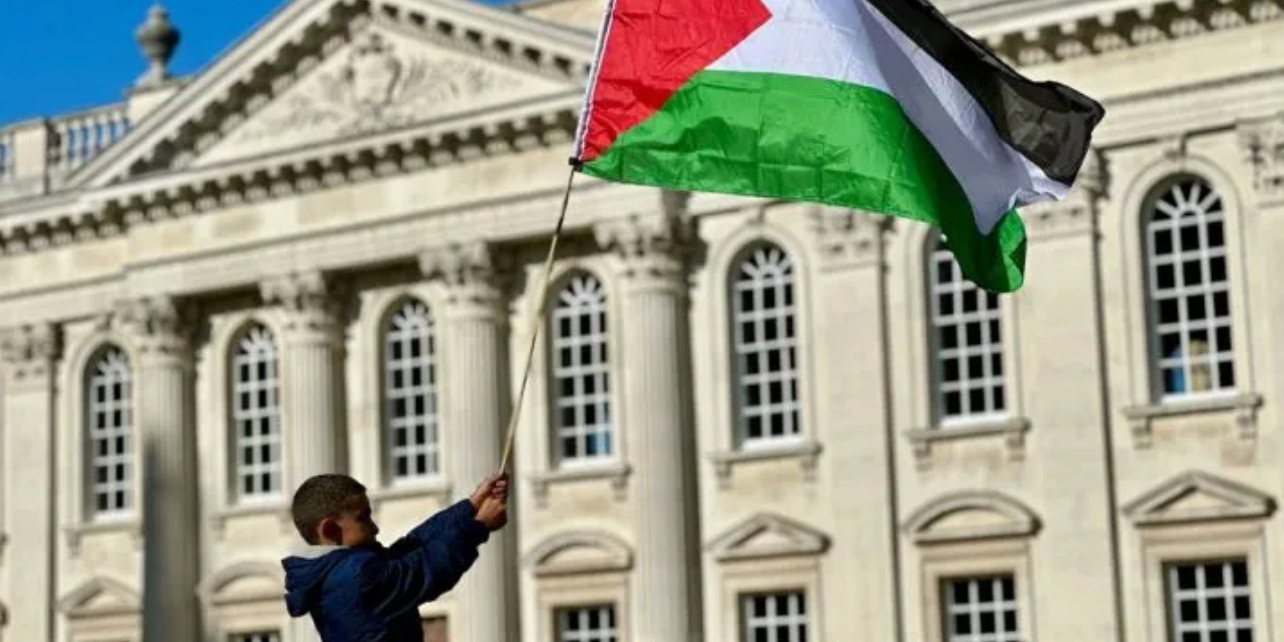
The United Kingdom is witnessing growing public outrage following a government-led crackdown on pro-Palestinian demonstrations.
The move has sparked serious concerns about civil liberties, freedom of expression, and the future of peaceful protest in Britain.
Since the onset of Israel’s war in Gaza, protesters across the UK have taken to the streets to denounce what they describe as genocide—citing the United Nations definition as “a crime committed with the intent to destroy a national, ethnic, racial or religious group, in whole or in part”.
However, recent developments have made such activism increasingly risky, with arrests being made for actions as simple as wearing a badge or attending a protest.
Over the weekend, demonstrations were held in cities including Edinburgh, Truro, Manchester, Bristol, and London. More than 100 peaceful protesters were arrested.
Among them were elderly individuals, including an 81-year-old former magistrate and another woman seen walking with a stick, raising alarms about the disproportionate policing of these events.
Some protesters now face up to six months in prison for merely displaying supportive slogans on clothing, or up to 14 years under terrorism laws for backing Palestine Action—a protest network founded in 2020 to oppose what it calls Israeli apartheid. Palestine Action defines its actions as “non-violent yet disruptive”.
The Home Office recently classified the group as a terrorist organisation under the Terrorism Act 2000, after damage was reported at RAF Brize Norton. This move has criminalised public support for the group, including wearing its insignia, holding placards, or even expressing solidarity.
Palestine Action’s legal team challenged the decision in court, seeking an injunction to halt the ban, but the High Court ruled against them. A further legal challenge was heard on 21 July, with barrister Raza Husain KC stating that the decision to proscribe the group was “repugnant” and represented “an authoritarian and blatant abuse of power”. A verdict is expected by 30 July.
While demonstrators in the UK have rallied against the ongoing violence in Gaza, governments worldwide have largely remained hesitant to label the actions of the Israeli military as genocide or to impose meaningful sanctions. However, international momentum appears to be shifting. A 30-nation meeting held in Colombia saw several countries from the Global South advocate for measures to curb Israeli aggression, including arms embargoes and a ban on weapons transport.
Domestically, the UK has joined 25 international partners in issuing its strongest statement yet on the conflict. The joint declaration condemned the “inhumane killing of civilians, including children, seeking to meet their most basic needs of food and water”, calling on “all parties to protect civilians and uphold the obligations of international humanitarian law”. It also stated: “We are prepared to take further action to support an immediate ceasefire and a political pathway to security and peace for Israelis, Palestinians and the entire region.”
Still, many are questioning the uneven policing response across the UK. More than 100 individuals have been arrested for peacefully protesting in support of Palestine, while only six arrests were made after violent far-right clashes in Essex. That incident, which took place outside a hotel housing asylum seekers, saw objects thrown, officers injured, and police property damaged.
While the Essex crimes may amount to criminal damage or public disorder, they stand in stark contrast to the terrorism-related charges now facing pro-Palestinian activists. Critics argue that the rushed proscription of Palestine Action is a dangerous overreach by the Home Office, undermining both the right to dissent and the principles of British democracy.
Unless this law is reversed, many fear it could mark the beginning of a broader erosion of the right to peaceful protest in the UK.
