
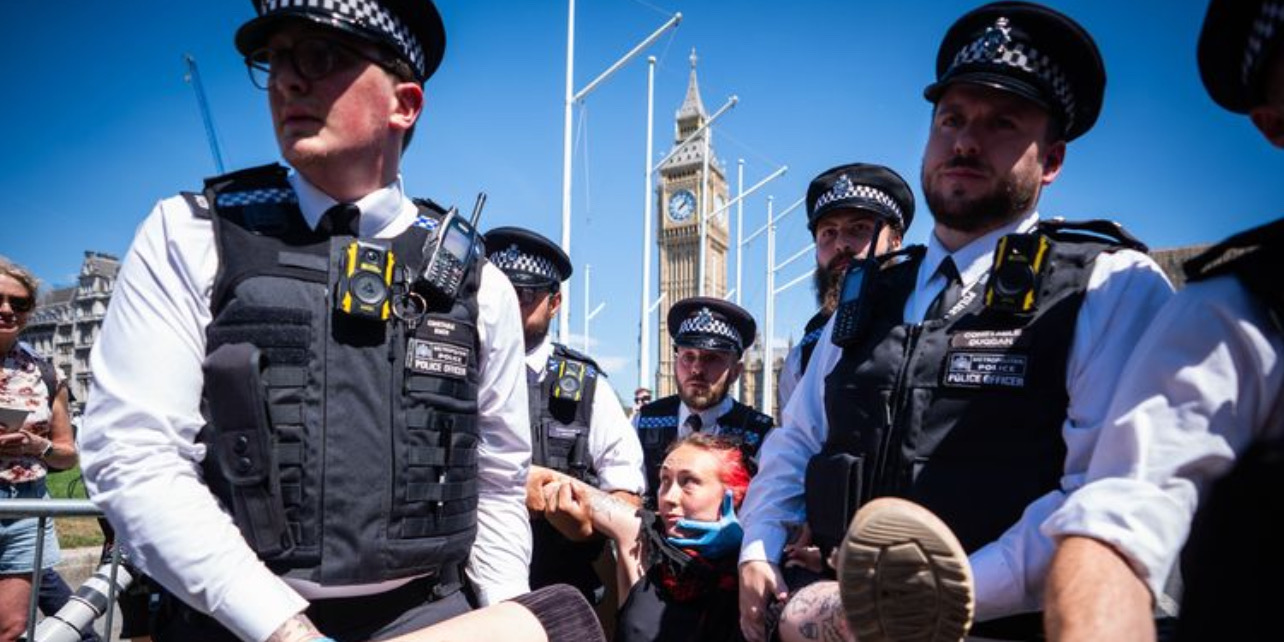
More than 70 individuals have been arrested during coordinated protests across the UK opposing the government’s recent decision to proscribe Palestine Action as a terrorist organisation under the Terrorism Act 2000.
Police in London, Cardiff, and Manchester confirmed multiple arrests linked to terrorism-related offences, following nationwide demonstrations led by the campaign group Defend Our Juries.
The Metropolitan Police reported 41 arrests in the capital on suspicion of supporting a proscribed group, with one additional arrest for common assault.
Protesters converged on Parliament Square for a second consecutive weekend, displaying placards with slogans such as “I oppose genocide, I support Palestine Action.”
Scenes of demonstrators lying on the ground while officers conducted searches, confiscated banners, and checked identification were witnessed in central London.
Several individuals were physically removed or escorted to police vans, with the last protester cleared from the Nelson Mandela statue shortly after 14:30 BST.
Authorities have reiterated that under UK law, expressing support for a banned organisation, whether through chants, signs, logos, or clothing, constitutes a criminal offence.
In Cardiff, South Wales Police confirmed 13 arrests during a protest outside the BBC offices in Central Square, all on suspicion of backing a proscribed group. A spokesperson noted the force respects the right to peaceful protest provided it remains lawful.
Meanwhile, Greater Manchester Police said 16 people were detained in St Peter’s Square, also under the Terrorism Act.
The UK government officially proscribed Palestine Action last Saturday, making membership or public support a prosecutable crime.
The decision follows a series of high-profile actions by the group, notably the vandalism of military aircraft at RAF Brize Norton in June.
Four individuals have since been remanded in custody, charged with conspiracy to commit criminal damage and conspiracy to trespass on a protected site with intent to harm national security.
A fifth person, previously arrested for allegedly aiding an offender, has been released on bail, while another was released without charge. The RAF incident also triggered a nationwide review of military base security.
Last week, Parliament voted to amend counter-terror laws to include Palestine Action on the UK’s list of banned terror groups.
Home Secretary Yvette Cooper justified the move, citing the organisation’s escalating pattern of criminal activity, particularly targeting the UK defence sector. “We will not tolerate those who compromise Britain’s national security,” she stated.
However, the government’s decision has faced fierce backlash. Legal representatives for Palestine Action co-founder Huda Ammori argued in court that the ban represents an “authoritarian misuse” of anti-terror laws. A legal challenge aiming to pause the ban was dismissed.
The controversy unfolds against the backdrop of the ongoing Israel-Gaza conflict, which erupted after the 7 October 2023 Hamas attack on Israel, resulting in over 1,200 deaths and hundreds taken hostage. Since then, more than 57,800 people have reportedly been killed in Gaza, according to the Hamas-run health ministry.
