
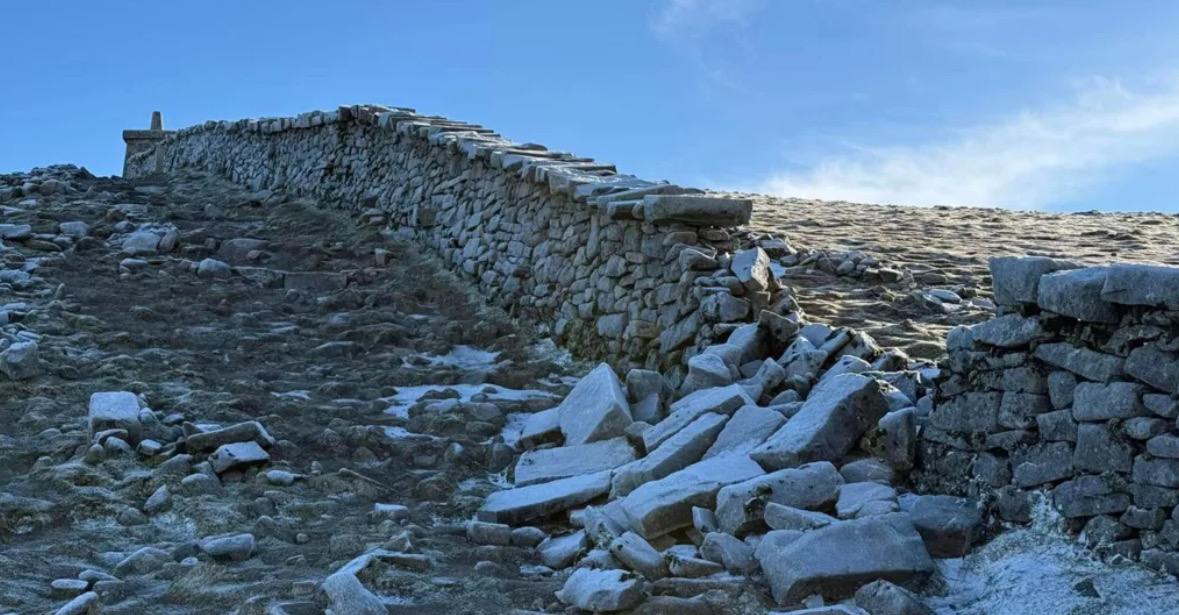
Storm Éowyn has left significant damage to the historic Mourne Wall in Northern Ireland, with repair costs estimated at around £650,000.
The powerful storm struck on 24 January with winds exceeding 90mph, leading to widespread disruption, including damage across six peaks in the Mourne Mountains.
NI Water, which owns the 22-mile-long Mourne Wall, recently completed a detailed foot survey to assess the impact.
The assessment revealed 63 separate wall collapses, affecting 700 metres of the structure. Damage was reported on several mountains, including Slieve Donard, Northern Ireland’s tallest peak.
The storm forced the nine-week closure of Silent Valley Reservoir and continues to restrict access to popular walking trails in the area. NI Water described the inspection as time-consuming due to the terrain and the need to examine each section carefully.
Although NI Water has invested £2.5 million into the Mourne Wall Restoration Project since 2017, most of the sections damaged by Storm Éowyn had not yet been refurbished. Phase one of the project was completed in 2018, with more than 600 repairs.
Phase two concluded in March 2024, adding over 300 more repairs across 15 mountains. Only one section previously restored was damaged by the storm, and it was affected by the collapse of an adjacent original segment.
The utility is now preparing a business case to include the new repair work in its 2025-2026 Capital Delivery Programme, pending funding approval.
The Mourne Wall, built between 1904 and 1922 using traditional dry stone walling techniques, is considered Northern Ireland’s longest listed building. It was originally constructed to prevent livestock from contaminating drinking water and has since become a landmark for hikers, often referred to as the handrail of the Mournes.
The Mournes, designated an Area of Outstanding Natural Beauty, also experienced over 140 wildfires last month, adding further environmental strain to the region.
