
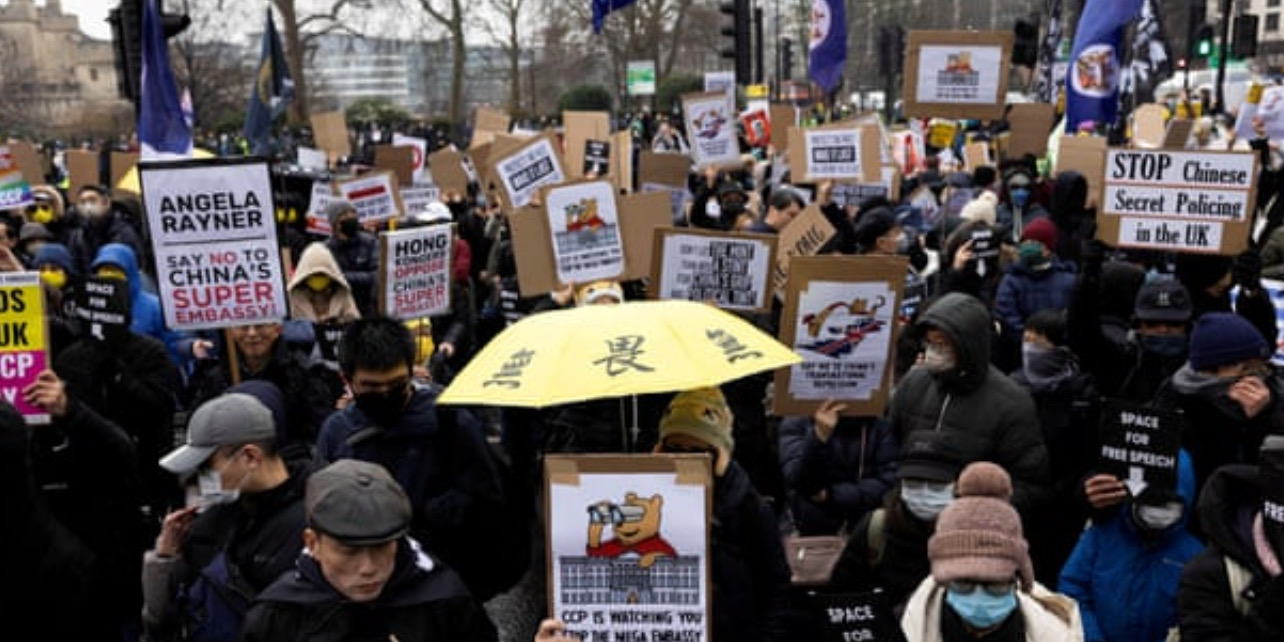
The Metropolitan Police have warned that China’s planned “super-embassy” in London could require significant additional police resources to manage potential large-scale protests, as ministers prepare to decide the project’s fate.
While the Met has officially withdrawn its objection, Deputy Assistant Commissioner Jon Savell stated the force “maintains concerns” that demonstrations involving more than 500 people outside the embassy could severely disrupt traffic and public order, demanding extra policing efforts.
In a letter addressed earlier this month to former Conservative leader Sir Iain Duncan Smith and the Home Office, Savell emphasised ongoing worries about the impact of the proposed embassy near Tower Bridge.
This follows two mass protests held at the site earlier this year, drawing crowds between 3,000 and 5,000—far exceeding the number the police believe can be safely accommodated.
The Chinese government intends to build a vast 20,000-square-metre embassy at Royal Mint Court, a Grade II-listed 18th-century complex.
Tower Hamlets Council originally rejected the application in December 2022, but China resubmitted its plans last summer following Labour’s ascent to power. Ministers subsequently took over the decision-making process, prompting a local inquiry that heard fierce objections from residents and campaigners.
The final decision now rests with Angela Rayner, Secretary of State for Housing, Communities and Local Government.
Previously, in December, the Met raised concerns that gatherings of over 100 people would overflow onto surrounding roads, posing safety risks and city-wide disruption. However, the following month, after reassessing a technical study funded by China, which suggested 2,000 demonstrators could be safely managed, the Met withdrew its formal objection.
This move paved the way for the embassy project to proceed, although Tower Hamlets Council reaffirmed its opposition at the time. However, with the Met’s revised stance, the council conceded it could no longer rely on police evidence to block the scheme.
During February’s local inquiry, legal representatives for residents accused ministers of exerting pressure on the Met to support the embassy plans.
Meanwhile, Foreign Secretary David Lammy and Home Secretary Yvette Cooper have both publicly backed the project. In a joint letter published in January, they emphasised “the importance of maintaining functional diplomatic premises in capitals,” though they acknowledged “differences of opinion” regarding protest management at the site.
Securing approval for the new embassy has become a diplomatic priority for Beijing, particularly as the UK seeks to strengthen economic and political ties with China.
