
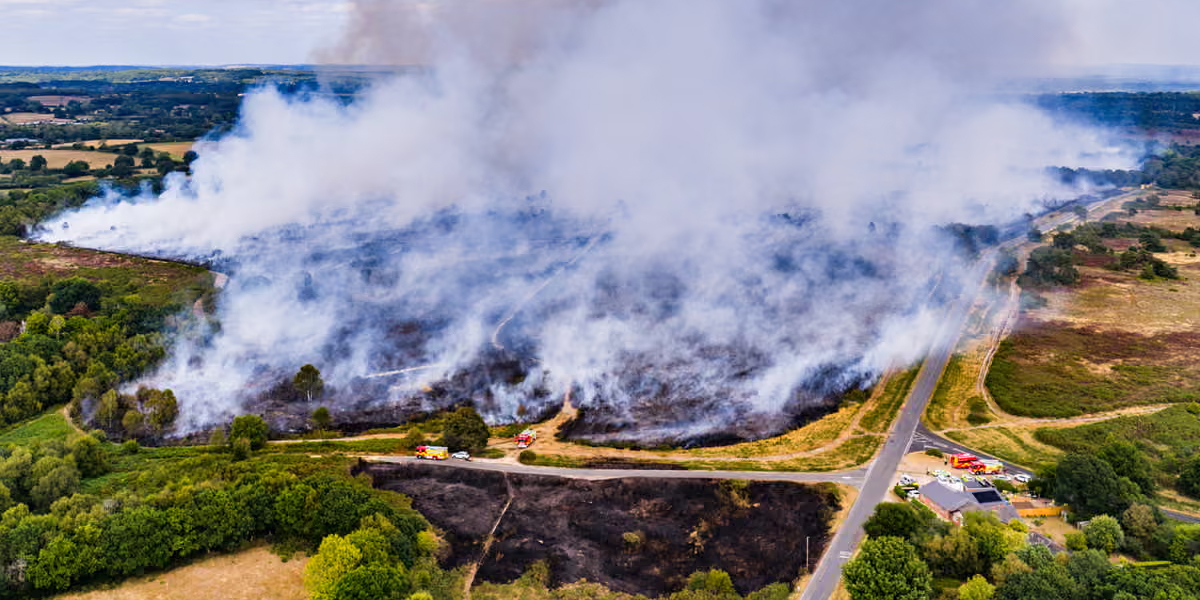
Wildfires have burned more of the UK’s moorland, forests and farmland in 2025 than in any previous year, new data shows, placing unprecedented pressure on the country’s already overstretched fire and rescue services.
Figures from the Global Wildfire Information System estimate that by November, 47,026 hectares (116,204 acres) had been destroyed across the UK. This marks the largest area burned since monitoring began in 2012, and more than double the land lost during the record-breaking summer of 2022.
The Fire Brigades Union (FBU), supported by a range of climate and tax justice organisations, has issued a strong warning to the government. In a joint letter to the chancellor, the groups call for long-term investment to help fire and rescue services cope with worsening wildfire and flooding risks linked to the climate crisis.
The letter states:
“There is stark evidence that the UK is dangerously underprepared for the growing threat of wildfires, flooding, and the wider impacts of the climate crisis.”
It continues: “That is why we are writing to you… to ask you to make substantial, long-term investment in the UK’s fire and rescue service.”
Recent large-scale fires have highlighted growing gaps in local firefighting capacity.
At Holt Heath in Dorset in August, firefighters from across the UK were brought in to battle a “relentless” blaze because local resources were “shockingly thin on the ground”.
In September, crews in North Yorkshire were joined by farmers, gamekeepers and landowners as they tackled a huge fire on Langdale Moor that burned for weeks.
The letter points out that the fire and rescue service has lost nearly 12,000 firefighters since 2010, the equivalent of one in five roles. Central government funding has also fallen by 30 per cent in cash terms, leaving services grappling with equipment shortages, understaffed control rooms and inadequate protective gear.
“This under-investment is impacting response to climate change incidents,” the letter warns. During the Holt Heath wildfire, firefighters from as far away as Greater Manchester were drafted in, and many lacked specialist wildfire PPE, exposing them to increased risks of heatstroke, exhaustion and burns.
In addition to wildfires, fire services are also at the forefront of the UK’s increasingly severe flooding emergencies.
Recent reporting revealed that millions more homes across England, Scotland and Wales will face destructive floods in the coming years, with some towns potentially becoming uninsurable or requiring managed retreat as climate impacts intensify.
Sam Harding, a Monmouth firefighter who helped rescue residents during Storm Claudia, said the service is struggling to meet the scale of the challenge.
“The flooding was some of the worst we’ve had in recent years, and required all of our water rescue resources,” he said. “If there had been another flooding incident elsewhere in south Wales requiring water rescue, I don’t know how we would have been able to respond.”
He added that sustained cuts mean the resilience simply “isn’t there” to cope with multiple severe incidents, which are becoming more frequent.
The letter, signed by Greenpeace, Tax Justice UK, Friends of the Earth and others, urges the chancellor to significantly increase funding to ensure sufficient firefighters, control staff and specialist resources to meet escalating wildfire and flooding risks.
“We urge you to act decisively to provide the investment, strategy and leadership that firefighters and the communities they protect urgently need to tackle the realities of climate change,” the organisations conclude.
