
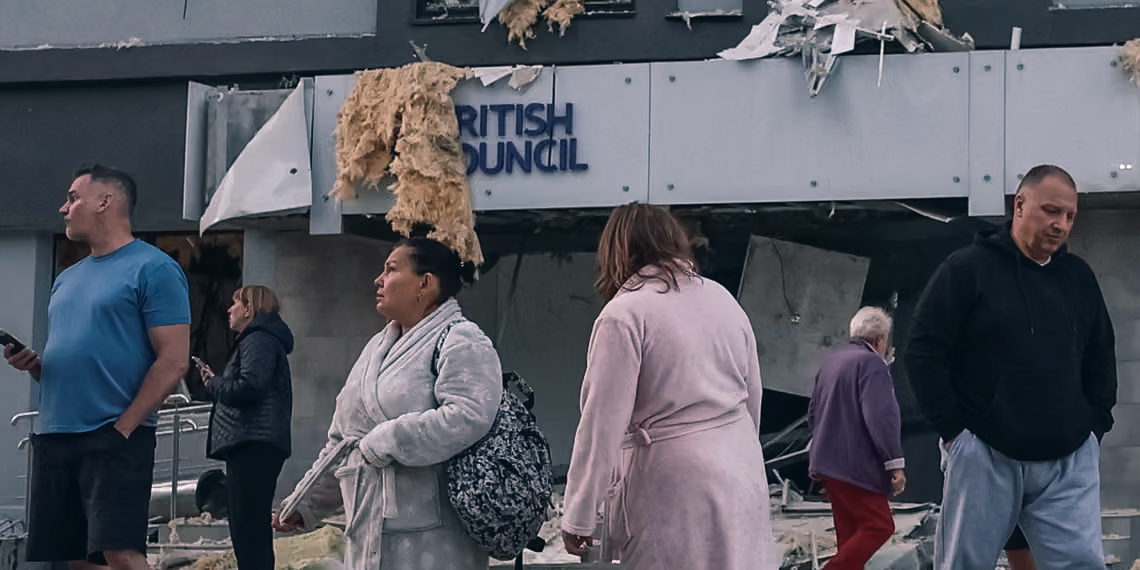
The United Kingdom has summoned Russia’s ambassador in London after deadly missile strikes on Kyiv left at least 17 people dead and caused severe damage to the British Council office in the Ukrainian capital.
The Russian ambassador, Andrey Kelin, was called to the Foreign Office at 1pm on Friday following confirmation that the building had been struck by shrapnel. This marks the first time that British government property has been caught up in a Russian attack on Ukraine.
Foreign Secretary David Lammy condemned the strikes, saying they killed civilians, destroyed homes and damaged international buildings, including the British Council and the European Union delegation. He added that Moscow’s campaign of destruction must end immediately.
Prime Minister Keir Starmer described the attacks as senseless and accused the Kremlin of deliberately sabotaging peace efforts.
Although the British Council’s office in Kyiv was not directly targeted, it suffered significant damage from falling debris. A security guard was injured but remains in a stable condition. Images released online showed the building with shattered windows, a collapsed entrance and debris strewn across the pavement.
The European Union’s delegation, located in the same block as the British Council, was also badly hit in the strikes. No EU staff were injured, but Brussels has summoned Russia’s envoy in protest. EU foreign policy chief Kaja Kallas said the assault was a deliberate attempt to escalate the conflict and undermine peace talks.
Four children are among the 17 people confirmed dead so far, Kyiv officials said, warning that the toll could rise as rescue teams search through the rubble. European Commission President Ursula von der Leyen expressed outrage, accusing the Kremlin of terrorising Ukraine and indiscriminately killing civilians.
Russia’s defence ministry claimed its missiles were aimed at Ukrainian military and industrial sites, insisting the strikes were not directed at civilian infrastructure.
In a post on social media, Starmer said his thoughts were with those affected by the attack, adding that Vladimir Putin was killing children and civilians in a campaign of bloodshed that must stop.
For more than 30 years, the British Council has played a key role in strengthening cultural and educational ties between Britain and Ukraine. Following the incident, the organisation confirmed that its Kyiv office will remain closed until further notice, but stressed that its work with Ukrainian partners will continue uninterrupted.
The attack comes against a backdrop of renewed diplomatic tension. Earlier this month, US President Donald Trump held separate meetings with Putin in Alaska and Ukrainian President Volodymyr Zelensky in Washington, raising hopes of a possible dialogue. However, Moscow has since dismissed suggestions of talks between Putin and Zelensky.
Meanwhile, Britain has stepped up pressure on the Kremlin. Foreign Office minister Stephen Doughty recently announced sanctions against eight organisations and individuals accused of helping Russia evade financial restrictions, including through crypto networks. Moscow retaliated with sanctions against 21 British figures, including journalists and former MPs.
The European Commission is also preparing a new package of sanctions, the nineteenth since Russia’s full-scale invasion began in February 2022. Von der Leyen confirmed that Brussels is advancing plans to use frozen Russian assets to support Ukraine’s defence and reconstruction.