
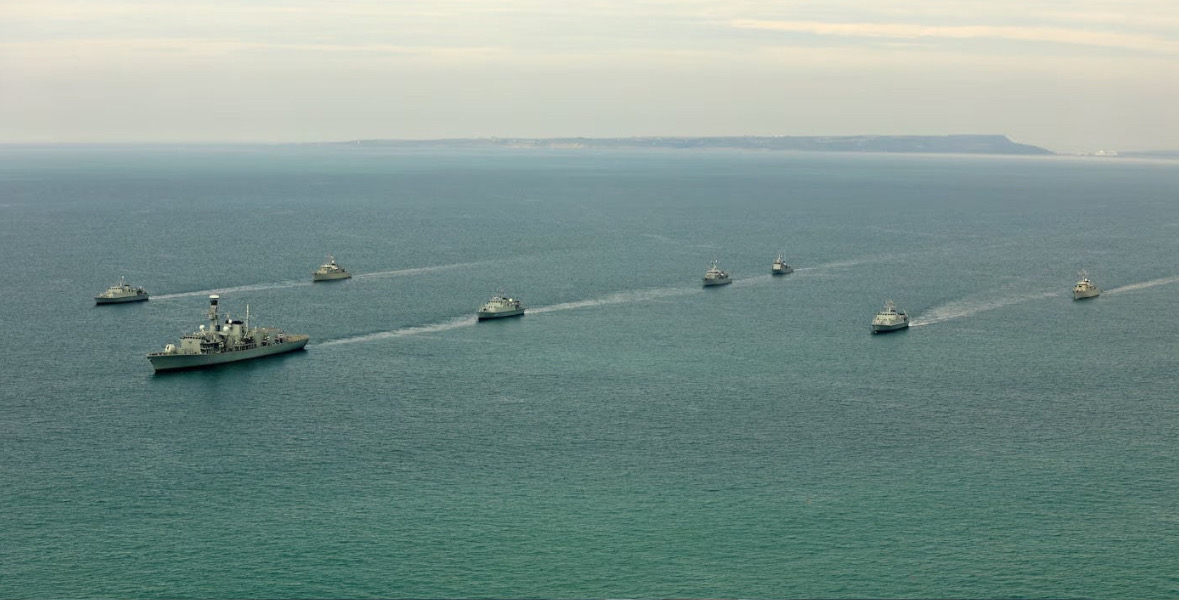
A major multinational naval exercise, Sea Breeze 25-2, has wrapped up off the south coast of the United Kingdom, following two weeks of intensive mine warfare operations involving 14 countries.
Co-hosted by the United Kingdom and the United States, the large-scale exercise ran from 30 June to 11 July, bringing together NATO allies and partner nations to enhance joint capabilities in mine countermeasures (MCM), explosive ordnance disposal, and maritime robotics.
Participating nations included the UK, US, France, Spain, Türkiye, Greece, Sweden, Denmark, Bulgaria, Estonia, Georgia, Latvia, and Poland. Naval forces were primarily based around Portland Port, conducting a range of operations in nearby waters.
The exercise featured advanced maritime technologies such as remotely operated vehicles (ROVs), autonomous underwater systems, electronic warfare tools, and live dive-and-salvage operations. A final demonstration tested real-time coordination and decision-making, simulating complex threats through a multi-domain command and control structure.
Sea Breeze 25-2 focused on strengthening allied coordination during high-pressure maritime scenarios, reflecting a growing emphasis on interoperability and rapid response in contested waters.
The U.S. Navy, which led the exercise, highlighted the importance of allied cooperation in mine warfare. Capt William Williams, Commodore of Mine Countermeasures Group 6, noted that maintaining open sea lanes requires strong partner support due to the limited size of the U.S. MCM force.
Originally launched in 1997 as a joint US-Ukraine initiative, Exercise Sea Breeze has traditionally been held in the Black Sea. However, the 2025 edition marks a strategic shift, with operations moving to other high-risk areas such as northern Europe and the North Atlantic approaches.
This year’s activities were divided into two phases: Sea Breeze 25-1 took place in Romania in June, while Sea Breeze 25-2 brought joint naval activity to UK waters in early July. Both phases aimed to enhance coordination across sea, land, and air forces, amid growing concerns over maritime access and seabed security.
The success of Sea Breeze 25-2 underscores the continued importance of allied preparedness and technological innovation in modern naval operations, particularly as undersea threats and strategic maritime routes draw increasing attention from global powers.