
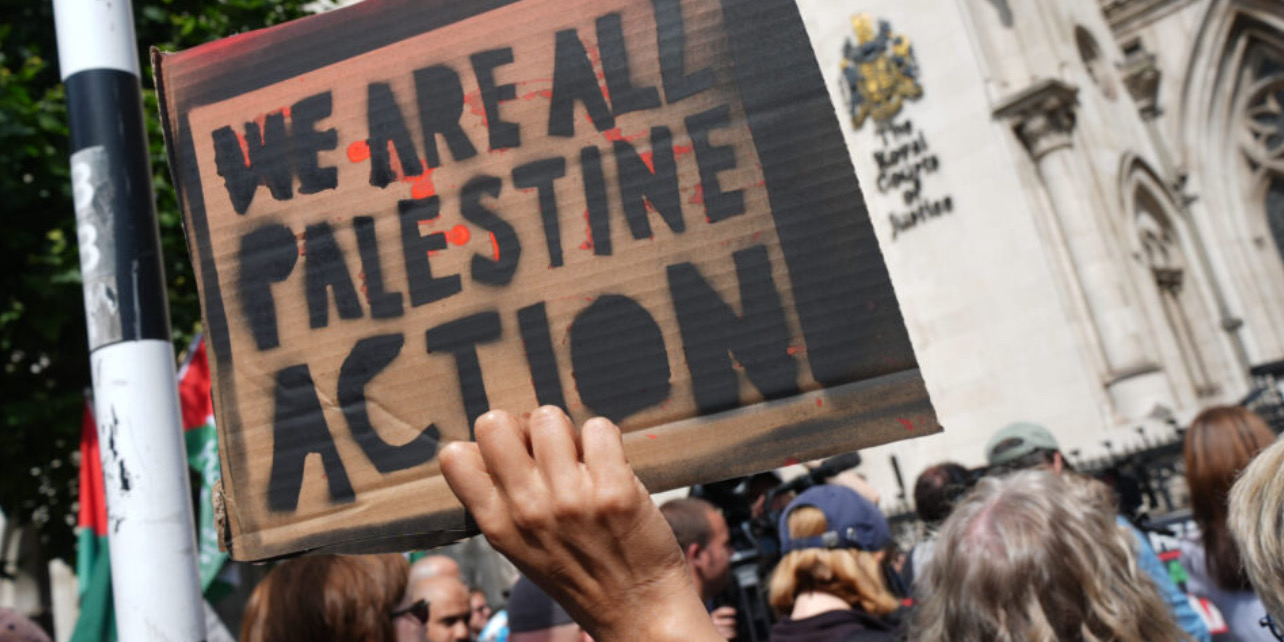
Protests broke out once again in central London on Saturday as demonstrators voiced opposition to the UK government’s decision to classify the activist group Palestine Action as a terrorist organisation.
This marks the second consecutive weekend of protests as tensions escalate over the controversial designation.
Activists gathered in Parliament Square, where two small groups staged a silent protest at the statues of Mahatma Gandhi and Nelson Mandela. The action, organised by the campaign group Defend Our Juries, began at around 1 PM. Protesters held signs reading messages such as “I oppose genocide, I support Palestine Action”, written in black marker on cardboard.
The demonstration took place under a heavy police presence. Officers from the Metropolitan Police formed a cordon around the Gandhi statue, monitored the protest closely, and searched the bags of participants. IDs were also checked, and 29 people were arrested during a similar protest the previous weekend.
Protesters were later escorted from the scene and placed into police vans stationed nearby. Some were seen lying on top of each other while holding handmade signs, highlighting the peaceful but defiant tone of the protest.
Saturday’s protest is part of a broader wave of planned demonstrations, with similar actions expected in Manchester, Cardiff, and Londonderry in Northern Ireland.
The Metropolitan Police reaffirmed its position that public support for proscribed organisations, including chanting, wearing symbolic clothing, or displaying signs or logos associated with such groups, constitutes a criminal offence under UK law. Supporting or being a member of Palestine Action now carries a potential prison sentence of up to 14 years.
The ban on Palestine Action follows an incident on June 20, when the group claimed responsibility for damaging two Voyager aircraft at RAF Brize Norton in Oxfordshire. Authorities estimate the damage at around £7 million.
UK Home Secretary Yvette Cooper defended the decision to outlaw the group, calling the aircraft vandalism disgraceful and citing what she described as a long-standing pattern of criminal activity.
The government’s move has sparked backlash from civil liberties advocates and pro-Palestinian activists, who argue that the ban stifles dissent and criminalises legitimate protest. The coming weeks are expected to see continued unrest as legal challenges and further demonstrations take shape across the country.
