
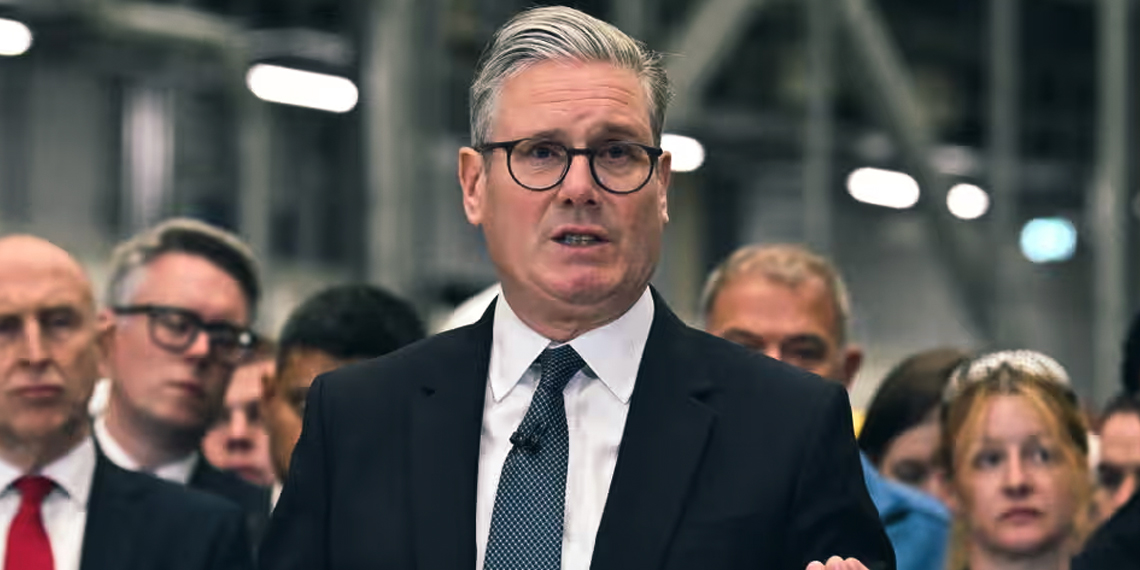
Prime Minister Keir Starmer has announced a sweeping new defence strategy to prepare Britain for escalating global threats, particularly from Russia, warning that the country faces daily dangers to its national security.
Unveiled at the BAE Systems shipyard in Glasgow, the government’s 130-page defence review outlines plans to bolster weapons production, increase investment in drone and submarine technology, and boost military readiness across Europe and the Atlantic. Starmer declared that Britain must shift to “war-fighting readiness” to deter Russian aggression.
The prime minister reaffirmed his commitment to raise defence spending to 2.5% of GDP by 2027–28, with an “ambition” to reach 3% during the next parliament — despite not giving a specific timeline. This move, he indicated, may come at the expense of other public spending, including welfare or foreign aid.
Starmer: National Security Comes First
Speaking from Scotland, where Labour is contesting a key byelection in Hamilton, Starmer stressed that defence takes precedence over other policy areas:
“This is a blueprint to make Britain safer and stronger, a battle-ready, armour-clad nation with the strongest alliances and most advanced capabilities,” he said.
He warned that Russian forces are already testing UK defences with incursions in British airspace and waters, as well as launching cyber-attacks.
“Russia is a real and present danger. We must prepare, not react,” he added.
Funding Without ‘Fantasy Politics’
When questioned about the source of funding, Starmer declined to set a precise date for the 3% GDP defence target, arguing he would only commit once the financial pathway is clear.
“I don’t believe in performative fantasy politics – especially not on defence and security,” he told BBC Radio 4.
Starmer reiterated that growing the economy remains his priority for funding long-term defence goals.
A Shift in Military Strategy – But No Army Expansion Yet
While the review focuses on enhancing Britain’s war-readiness, it does not commit to expanding the size of the armed forces immediately. Defence Secretary John Healey confirmed that any increase in troop numbers would be deferred until after the general election.
The review calls for increased stockpiles of military equipment and supplies, noting that current resources may last only days in a major crisis.
Starmer concluded: “We’ve seen the devastation caused by Russia’s invasion of Ukraine. We cannot assume it ends there. Britain must be ready for any scenario.”
