
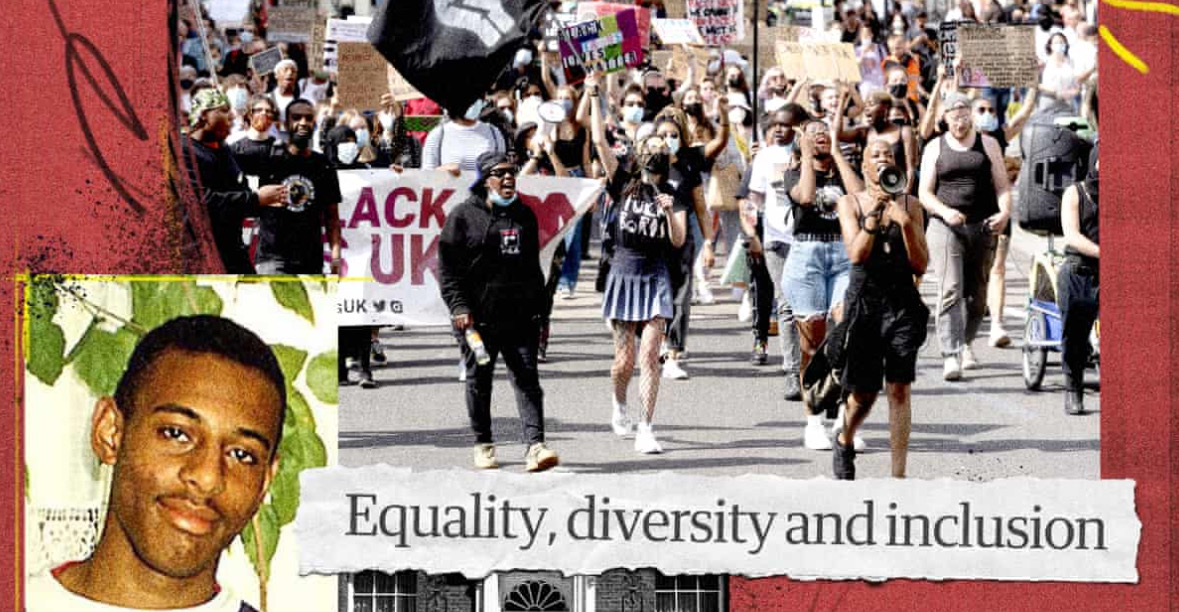
A comprehensive review has revealed that fewer than one-third of the recommendations made by official reports aimed at tackling institutional racism in the UK have been fully implemented, raising serious concerns about the government’s commitment to racial equality.
The analysis, conducted by The Guardian ahead of the fifth anniversary of the Black Lives Matter protests, examined 12 major government-commissioned inquiries dating back to 1981. These investigations were often prompted by high-profile incidents, such as the murder of Stephen Lawrence, the Windrush scandal, and public unrest in racially divided communities.
Out of nearly 600 recommendations covering critical areas such as education, healthcare, policing, and employment, fewer than 33% have been enacted in full. Another third were either ignored entirely or implemented only in a limited, symbolic, or inconsistent manner. Several key policies were initially introduced but later rolled back or dismantled during periods of austerity, especially throughout the 2010s.
Experts argue this reflects a long-standing pattern of performative action by successive governments — commissioning reviews to pacify public anger, only to sideline the findings over time.
Professor Ted Cantle, who led the Community Cohesion Review following the 2001 riots in northern England, said the UK has become trapped in a damaging “doom loop” of inaction. Only around 5% of his recommendations were fully adopted. He stressed the urgent need for a national cohesion strategy delivered at both central and local levels.
Lord Victor Adebowale, who chaired a 2021 review on mental health and policing, warned that continued neglect of racial disparities was costing lives. Of his 28 recommendations, only 14% have been fully implemented, while roughly a quarter were ignored altogether.
Data shows that Black men remain disproportionately affected across sectors, from being more likely to die in police custody, to experiencing poorer outcomes in healthcare, including later-stage cancer diagnoses and greater mental health detentions.
Political figures, including Labour MPs Clive Lewis and Bell Ribeiro-Addy, criticised the UK government for using race reviews as a means to suppress public outrage rather than to catalyse structural reform. Lewis stated that the country is stuck in a cycle of “crisis, commission, and conveniently shelved recommendations”, while Ribeiro-Addy claimed the government’s approach diverts attention from creating lasting change.
Despite this bleak outlook, some progress has been made in the private sector. The Parker Review, which targeted boardroom diversity in FTSE companies, set a benchmark for every FTSE 100 firm to include at least one minority ethnic director by 2021.
By early 2024, 95% had achieved this, suggesting that business leaders are making more tangible efforts than the state to address inequality.
Nevertheless, the broader picture reveals a troubling truth: over 40 years of racial equity efforts have delivered minimal results, with most state-led initiatives either stalling or failing outright. Campaigners and experts are calling for urgent action to break the cycle and build a fairer, more inclusive Britain.
