
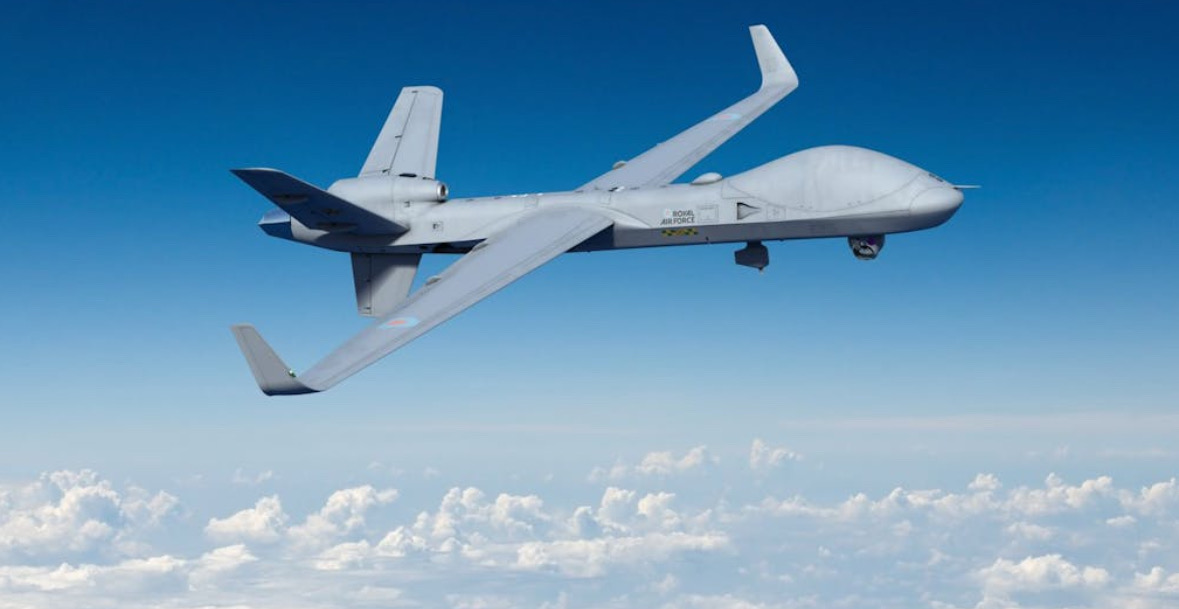
The UK Ministry of Defence has officially certified the Royal Air Force’s cutting-edge uncrewed aircraft, the Protector RG Mk1, for unrestricted operations over the UK – including populated areas.
This milestone follows the drone’s receipt of a Military Type Certificate (MTC) from the UK Military Aviation Authority, affirming its compliance with NATO’s stringent airworthiness standards.
The Protector RG Mk1, also known as the MQ-9B SkyGuardian and developed by General Atomics Aeronautical Systems Inc. (GA-ASI), becomes the first large uncrewed aircraft system in the world to be granted this level of certification.
The decision marks a major step forward in Britain’s push to modernise its defence capabilities with advanced unmanned technologies.
The Royal Air Force is introducing the drone at RAF Waddington in Lincolnshire, where 10 out of 16 ordered aircraft have already been delivered.
Designed for Intelligence, Surveillance, Target Acquisition and Reconnaissance (ISTAR) missions, the Protector drone will support both UK and allied operations, offering unmatched long-endurance and precision capabilities.
With the MTC in place, the Protector can now operate freely in UK civilian airspace without restrictions based on geography or population density. This is a key requirement for future operations, allowing seamless integration of military drones alongside commercial aircraft – something not previously possible with its predecessor, the Reaper.
The certification follows an extensive safety and airworthiness assessment aligned with NATO’s STANAG 4671 Edition 2 standards. These assessments included environmental testing, full-scale fatigue testing, and the development of over 140,000 pages of technical documentation, verifying the aircraft’s durability and safety.
The MQ-9B is built to strict aerospace safety specifications, featuring fire protection systems, lightning protection, anti-icing capabilities, and software separation between flight-critical and mission-specific systems. These design elements make it uniquely suited for safe operations over civilian populations.
The project, which cost over \$500 million and spanned more than a decade, reflects the RAF’s commitment to maintaining operational superiority through innovation. General Atomics hailed the certification as the result of years of engineering excellence and international collaboration.
Beyond the UK, several countries have expressed interest in the MQ-9B platform, including Belgium, Canada, Poland, Japan, Taiwan, India, and the United States. The drone has already taken part in multiple U.S. Navy exercises, showcasing its global interoperability and reliability.
The Protector RG Mk1 is the successor to the RAF’s Reaper drone, which has been in service since 2007. Unlike Reaper, which faced airspace restrictions, the Protector is designed to fly safely in shared civilian skies, making it a key asset for both military and humanitarian missions.
This development also comes at a time when drone warfare and unmanned surveillance play an increasingly vital role in global security strategy. The UK’s investment in next-generation systems like the Protector aligns with its broader defence modernisation agenda outlined in the Integrated Review.
With unrestricted flight approval now in place, the RAF’s new fleet of Protectors is set to transform how Britain gathers intelligence, monitors threats, and supports military operations both at home and abroad.
