
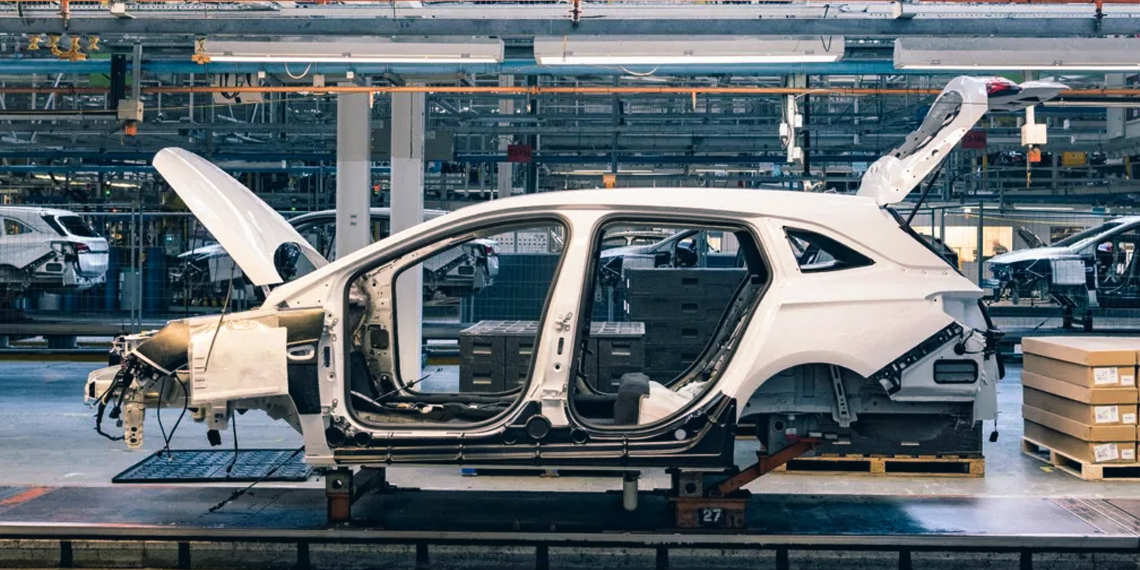
Car production in the UK saw a significant decline in April, marking the lowest output for the month in over 70 years—excluding 2020 when the pandemic halted operations.
According to the Society of Motor Manufacturers and Traders (SMMT), just 59,203 vehicles were built, down 16% compared to April last year and 25% lower than March 2025.
This sharp fall has been attributed to a combination of trade challenges, seasonal factors, and the ongoing shift from petrol to electric vehicle (EV) production. Easter, which fell in April this year, reduced the number of working days, further affecting output levels.
April’s figures represent the lowest non-pandemic April production since 1952, when 53,517 vehicles were built. Export demand also weakened, with car exports falling by 10.1%, driven by declining interest from key markets including the US and the EU.
Despite the downturn, the SMMT remains cautiously optimistic, pointing to potential future boosts from trade agreements currently being pursued with the United States, the European Union, and India.
The first four months of 2025 have collectively seen the lowest car production figures since 2009, highlighting the scale of the ongoing slowdown. The UK’s automotive industry is facing mounting pressure, compounded by global challenges and domestic policy uncertainty.
Professor Peter Wells from the Centre for Automotive Industry Research at Cardiff University noted that similar production drops are being seen in Germany, France, Italy, and Japan, suggesting this is part of a broader global trend rather than a uniquely British issue.
However, the UK’s position may be particularly vulnerable. The country has fewer trade restrictions on Chinese vehicle imports compared to the EU and the US, potentially creating more competition for domestic manufacturers. In addition, the government’s recent relaxation of EV sales targets and emission standards has raised concerns about long-term investment and planning stability.
In recent years, several major carmakers have scaled back or shut down UK operations, including Honda and Ford. Stellantis, which owns Vauxhall, Peugeot, and Citroën, previously warned that unclear EV policies could force it to reconsider its British manufacturing sites.
Experts agree that greater policy consistency is urgently needed to restore industry confidence. Without clarity on tariffs, electrification, and sustainability goals, the UK car manufacturing sector is likely to remain in a volatile state.
